The Weight You Gained After Menopause Isn't A Willpower Problem
A women's-health internist of 24 years explains why eating less stopped working after 50 — and the daily patch that finally moved the scale, without needles, prescriptions, or starving.
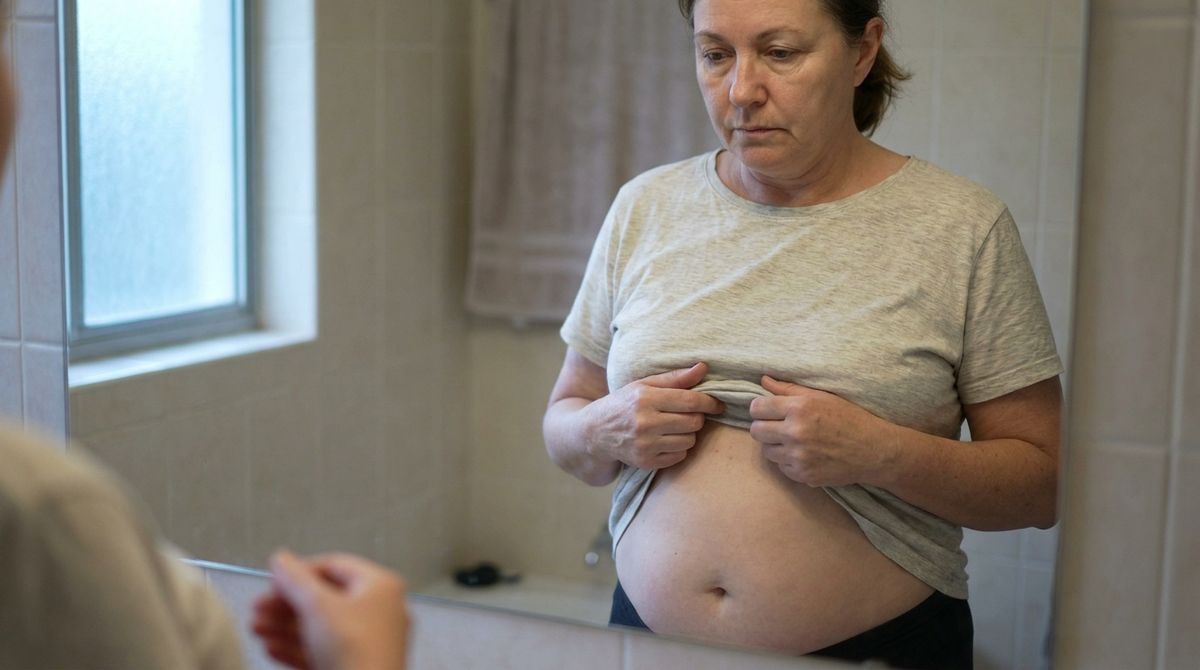
Dear Friend Who Gained Weight After Menopause,
If you eat less now than you did at 40 and the scale still won't move…
If you walk every morning and it changed nothing…
If you lie in bed and feel the pull to the kitchen anyway…
If you finished dinner an hour ago and your brain still says you're not done…
If your doctor ran every test and told you it's all "within normal range"…
If they said the words "it's just menopause, eat less" and you wanted to scream…
If you tried the shots and got scared of the needle and the price…
If you've started to believe your own body just gave up on you… Then what I'm about to tell you could change how you see every failed diet of the last ten years. Because you were told a lie.
Not a small one. You were told the weight was about what you put in your mouth.
That if you just wanted it badly enough, ate cleaner, moved more, you'd get your body back. So you did all of it.
And it didn't work.
And somewhere along the way you decided the problem must be you. It isn't. After 24 years treating women's metabolic health, I can tell you exactly what changed in your body after fifty, and it has nothing to do with how hard you're trying.
Your body stopped sending the one signal that tells your brain you've had enough. The signal quietly switched off, and no one told you.
I didn't understand that fully myself until I watched one of my patients, a woman I'd known for nine years, go quiet in a way that stopped me cold.
I'll tell you about her. Because her story is probably yours too.
For Years I Told Women There Was Nothing To Be Done
I'm a women's-health internist. 24 years in practice.
And for most of them, I gave the same answer everyone else did. "Your metabolism slows down. Eat a little less. Move a little more. It's just this stage of life." I believed it. Not because I didn't know the biology, I knew it cold. Because I had no other card to play.
I remember a woman named Carol in this office a few years back. She'd brought a spiral notebook where she'd written down everything she ate for six weeks. She slid it across my desk with both hands, like evidence.
"I did everything you said," she told me. The scale had gone up two pounds. I looked at her notebook.
Then I told her to keep at it and maybe cut the evening snack. I thought I was being kind. I was really just shrugging in a nicer voice.
I watched that not work, over and over, for years, and I kept saying the same thing. I told women their bodies had simply changed and there was nothing to be done. I was wrong about that last part.
And one of my own patients is the reason I finally admitted it.
The Night The Restaurant Forgot Her Name

Diane Foster has been my patient for nine years. Fifty-two, retired from flying, works the front desk at a dental office now.
She's the kind of person a waiting room could feel, she'd come in and everyone sat up a little. Last spring she came in quiet. Didn't take off her coat. Sat down with her purse still in her lap and told me about the Thursday before.
There's a little Italian place, Marino's, that she'd eaten at for fifteen years. The owner used to come out from the back and hug her at the door.
She put on a coral dress she keeps in her closet — the one she always wore there — and she drove over by herself. She got to the host stand and stopped.
A girl was standing behind it, maybe twenty, looking down at the reservation book. Diane stood there with her hand on the edge of the wood. She could smell the garlic coming out of the kitchen, the same as it had smelled for fifteen years.
The girl didn't look up. Diane waited.
She told me she counted the little laminated menus stacked under her hand — there were six of them — and she kept gripping the edge of the stand until the top menu had gone soft and warm from her palm. Almost four minutes.
She finally said her own name out loud. The girl looked at her the way you look at a stranger who's blocking the aisle. "Do you have a reservation?"
To a woman half that staff used to know by heart. Diane said no, that's okay, and she turned around and walked back out. She got in the car with her coat still on.
She didn't drive right away. She just sat there in the coral dress in the parking lot with the engine off. When she told me this she wasn't crying.
That was the part that got me. She said it flat, folding and unfolding the strap of her purse in her lap. "I guess this is just what happens," she said.
"You turn fifty and the world quietly puts you in the back." And I almost gave her the answer. Eat a little less.
Move a little more. It's just this stage. I had the words halfway out.
Then I looked at her hands, still going on that strap, and I couldn't say it. Because I didn't believe it anymore. I just hadn't figured out yet what I believed instead.
Everything She Tried, And Why None Of It Moved The Scale

Diane did not sit still. She never had. By the time she came back to me last spring, there was a shelf in her bathroom of half-used bottles and a body worn out from trying. Here is what she'd done, and here is why not one of it worked.
- A stricter diet, and a menopause trainer three days a week. She was eating less and moving more than she had at forty. The scale didn't move an ounce. Because the problem was never how much went in her mouth. It was a hunger signal that never once shut off.
- A full hormone and thyroid panel. Everything came back "within normal range." But normal range is a band wide enough to fit a twenty-year-old and a seventy-year-old at the same time. Sitting at the bottom of it isn't nothing wrong. It's the exact thing wrong that nobody thought to measure.
- Intermittent fasting. She dropped three pounds and gained them back in two weeks. Starving the body harder only makes it grip fat tighter. It does nothing to bring back the fullness signal she was missing.
- Months of a strict Mediterranean diet. Clean, careful, perfect. And she still lay awake at night fighting the pull toward the kitchen. Good food doesn't rebuild a hormone.
- She looked hard at the shots, Ozempic and Wegovy. She was terrified of the needle. She couldn't stomach a thousand dollars a month. And she read that most people put nearly all of it back on within a couple months of stopping, because a synthetic fix never teaches your body to make its own again.
What Was Actually Broken
So I kept looking, because Diane deserved a real answer and I didn't have one yet.
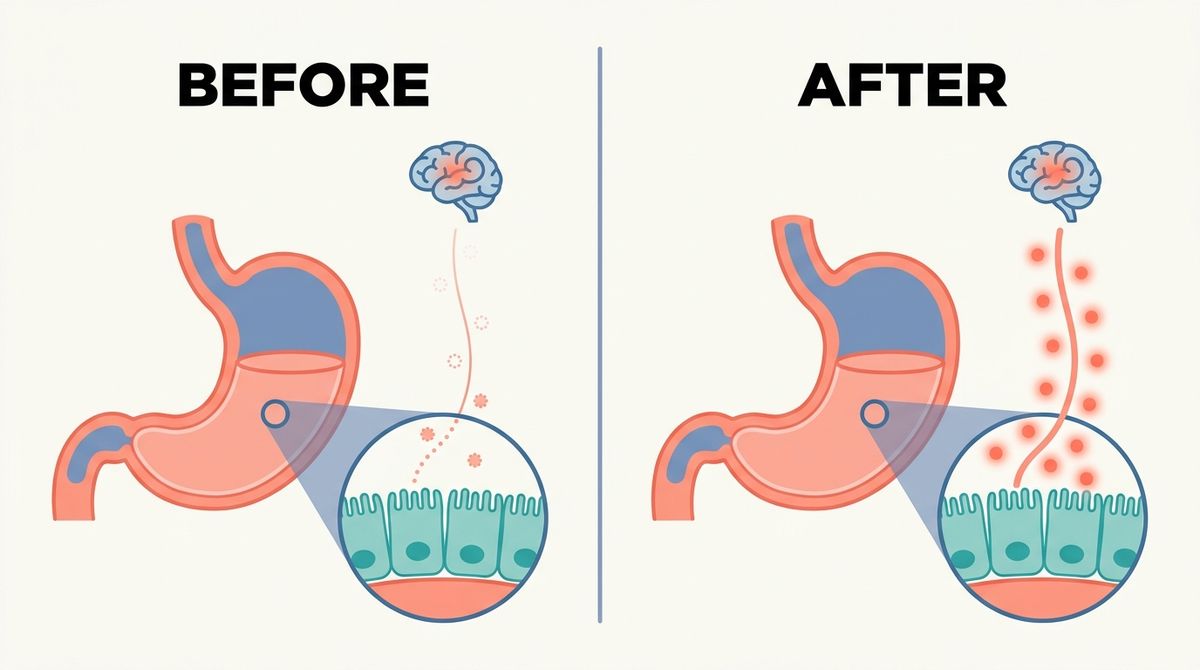
Here is what I finally landed on, and it is simpler than anything I'd been telling women for years. There's a hormone your gut makes called GLP-1. It's the thing that tells your brain you've had enough. When it's working, you finish a meal and the wanting just stops. When it's not, you can eat a full plate and your brain never gets the message.
And here's the part nobody warned her about. By the mid-fifties, most women have lost more than half of it. Estrogen falls, the gut cells that release GLP-1 slow down, and the signal quietly goes dead. So she wasn't weak. Her body had simply stopped ringing the bell.
Think of a doorbell with a dead battery. Diane was standing right at the door every night. A full meal in her stomach, exactly the way it's supposed to work.
But the bell never rang. And when nobody inside hears the bell, the house keeps calling out for more. That's why the diet didn't touch it.
You can stand at that door all day. If the battery's dead, nobody's coming. That's why fasting made it worse.
Starve the body and it just leans harder on the one signal it has left, which is hunger. And that's why her labs looked "fine." Nobody was measuring the battery.
They were checking the paint on the door. Now, why did this stay buried for so long? Because it's easier.
It takes ten seconds to tell a fifty-two-year-old woman to eat less and walk more. It takes real work to explain that the machinery that made "eat less" possible in her thirties has quietly powered down. One of those answers keeps the appointment moving.
The other one is true. For twenty-four years I gave the easy one. I don't anymore.
The Fullness Signal That Never Rings
Here is the part no one told Diane, and no one had told me clearly enough either.
When you finish a meal, your gut is supposed to send a message up to your brain. That message says one thing: enough. It's carried by a hormone your gut makes, called GLP-1.
When it works, you eat, you feel done, you push the plate away and stop thinking about food.
After menopause, your gut makes far less of it. By the mid-fifties, most women are producing less than half the GLP-1 they made at forty. So the meal goes in. Your stomach is full. But the message never gets sent.
Your brain sits there waiting to hear "enough," and it never hears it. So it keeps asking. That's the pull to the kitchen at nine at night.
That's the second helping you didn't plan on. Not weakness.
A message that stopped being sent. Think of a doorbell with a dead battery. You can be standing right at the door, a full meal in your stomach, hand on the button, but if the battery's gone, the bell never rings, and nobody inside ever knows you're there.
So the person inside keeps waiting, keeps wondering where you are, keeps calling out. Your brain is that person. It never got the ring, so it keeps calling for more food.
That's why the diet didn't work. You can eat less all you want. It doesn't fix a bell that won't ring.
And that's why the panel came back "normal." Nobody measured the bell. They measured the thyroid and the estrogen and shrugged.
The one thing that was actually broken was the one thing that never showed up on the page. The good news is simple. A dead battery isn't a broken door.
You don't replace the house. You get the bell ringing again.
How You Get The Bell Ringing Again
Once I understood the problem was a signal, not a calorie count, the fix got clear. To bring the fullness signal back, three things have to happen — and they have to happen together. Not one at a time. All at once. Here's what that takes.
- Wake the gut cells back up. There's a plant compound called berberine that nudges the exact cells in your gut that release GLP-1 to start firing again. This is the fresh battery going into the bell.
- Keep the signal steady all day. A fresh battery isn't enough if the bell only rings once. Prebiotics — food for the good bacteria in your gut — keep those cells producing steadily, so the fullness signal holds through the afternoon and the evening instead of spiking once and dying by dinner.
- Skip the stomach entirely. Here's the piece everyone gets wrong. Swallow berberine in a pill and your own digestion tears most of it apart before it does a thing. So you deliver it through the skin, slowly, over about eight hours — the way a nicotine patch works — and your stomach never gets the chance to destroy it first.
When A Colleague Called It Reckless
I didn't set out to fight anyone. I just had one patient — Diane — feeling something quiet down inside two weeks that nine years of diets never touched. The pull to the kitchen at nine at night. Gone.
She said it plainly: "For the first time in years, I ate dinner and just felt done." So I started using the same approach with other women in her age group.
And I made the mistake of saying so out loud, at a regional internal-medicine dinner, to a doctor I'd trained under. He set his fork down.
Told me I was being reckless — that if a woman needed help she should be on a real GLP-1 drug, under supervision, not "messing around with berberine and a sticker." I understood the reflex. I'd have said the same thing five years ago.
But I'd watched Diane. I'd watched the ones after her. And I wasn't willing to send them back to a needle and a $1,000 bill when their own bodies just needed the battery changed.
What I Finally Put In A Patch

So I stopped recommending things and started building one. I partnered with a small US formulation team, third-party testers, the kind who send the batch back if a number is off, and we spent months getting the two things that matter into one daily patch, in a form that actually reaches the gut cells instead of getting torn apart on the way.
They call it Ledisa. It isn't a diet. It isn't a drug. It's the fresh battery for the bell — worn on the skin, doing its quiet work for eight hours while you go about your day. Here's what's actually in it that matters:
- Berberine — a plant compound that taps the cells lining your gut on the shoulder and gets them releasing GLP-1 again, so the fullness signal starts ringing.
- Prebiotics — food for the good bacteria in your gut, the ones that keep those cells firing steadily instead of sputtering out by mid-afternoon.
- A through-the-skin patch — not a pill. It slips past your stomach entirely, so your digestion never breaks the good stuff down before it can work.
What The First Month Actually Looks Like
I won't hand you a tidy chart, because that's not how it went for Diane and it won't be how it goes for you. The first few days, most women feel nothing much. That's normal, you're waking cells that have been dozing for years. Somewhere in the second week is when it usually shifts.
The nine-o'clock pull to the fridge gets softer. You finish a plate and, oddly, you're just… finished. Diane noticed it before the scale did.
Weeks three and four are uneven. Some days the old craving elbows back in, especially if you slept badly. Then two quiet days follow.
It isn't a straight line down. By the end of the first month the pattern holds more than it breaks. You're not white-knuckling anything.
You put the fork down because your brain finally got the message it stopped getting somewhere around fifty-three. That's the whole difference — not more discipline. A signal that started ringing again.
What Happened When Diane Stopped Fighting Her Own Hunger

Diane started the patch on a Monday. She told me later she didn't expect a thing. The first week, not much. A little less reaching for the crackers she keeps in the drawer at the front desk. She wasn't sure it was real.
Then the second week, the pull to the kitchen at nine at night just wasn't there. She ate dinner and she was done. She kept waiting for the craving to come back like it always had.
It didn't. She told me the thing she noticed most wasn't the scale. It was that she stopped standing at the open fridge at night with the cold air on her legs, not even hungry, just pulled there.
She isn't the only one. Of the women in her age group who wrote back to us, the large majority said the food noise got noticeably quieter inside the first couple of weeks. Not gone in a day.
Not a miracle. Just the constant, exhausting negotiation with food finally going quiet — because the fullness signal was getting through again.
- most of the women in Diane's age group who wrote back said the food noise got quieter in the first couple of weeks
- ~2 wks when most first noticed they weren't standing at the fridge at night
- 8 hrs steady support from a single daily patch — no stomach to break it down
- 9 yrs Diane had been my patient before we found what was actually wrong
What The Other Answers Would Have Cost Diane
Let me lay out what Diane was looking at before she found this. The menopause-specialist trainer was $260 a month, three mornings a week, and she stuck with it for the better part of a year.
The full hormone and thyroid panel her doctor finally ran came to a few hundred dollars out of pocket, and every marker came back "within normal range." Then there were the shots. Ozempic and Wegovy run around $1,000 a month without insurance.
That's twelve thousand dollars a year to inject yourself weekly with something your body stops making on its own the moment you stop paying.
Weigh a patch that supports your own GLP-1 against any of that, and honestly it should cost what a month with that trainer cost.
Something in that range would still be a bargain next to a needle you rent for the rest of your life. It doesn't cost that. Not close.
Menopause trainer, 3x/week
- $260 a month
- The scale still didn't move
Total: ~$3,000/year
GLP-1 injections
- $1,000+ a month
- Needle, side effects, rebound
Total: ~$12,000/year
Ledisa patch
- One patch a day
- Supports your own GLP-1
Total: $29 a patch pack
What It Actually Costs
Here's the part I'm almost embarrassed to say out loud after those numbers. A pack of Ledisa normally runs $54.
On this page today it's $29. And they cover the shipping. That's under a dollar a day to support the one signal that quietly went missing after fifty — the fullness signal Diane spent two clean-eating years chasing without knowing what she was chasing.

You Don't Have To Decide Today Whether It Works
I understand the reflex. Diane had it too. After the trainer, the panels, the fasting, the months of perfect meals, she'd stopped believing anything new was worth the disappointment.
So here's how they've set it up, and it's the reason I was comfortable telling her to try it. You get 90 days.
Wear a patch a day and pay attention to the food noise — whether that constant pull toward the kitchen at nine at night starts to quiet down the way it did for the women in her age group who wrote back to us.
If it doesn't, you email them and you get every dollar back. Opened, half-used, doesn't matter. The trainer didn't give her ninety days to change her mind.
The shot company certainly doesn't. A company that hands you three months to decide is a company that already knows what usually happens in the first two weeks. That's not a sales line.
That's just the math of who offers a guarantee like that and who doesn't.
Keep waiting on the world to see you again
Another year of eating perfectly and standing at the host stand while the girl asks if you have a reservation. The signal stays off. Nothing you do reaches it, because you're still fixing the wrong thing.
Get the bell ringing again
Wear one patch a day, give it the ninety days, and find out — the way Diane did — whether the quiet inside your own kitchen was ever really about you at all.
How To Get Started
- Tap the button below to bring up today's page while the $29 batch is still in stock.
- Enter your shipping details — no prescription, no doctor's visit, nothing to sign up for.
- It arrives at your door in a few days.
- Put one patch on clean skin each morning, go about your day, and watch what happens to the food noise in the first two weeks.
A Quiet Gut Cell Doesn't Wait For You
Here's the part I need you to sit with. A gut cell that's gone quiet doesn't stay easy to wake forever. The longer that fullness signal stays dead, the more your body settles into the pattern of it.
It gets used to never hearing the bell. It keeps calling for food it doesn't need, and you keep answering, night after night, telling yourself tomorrow you'll finally have the discipline. But it was never discipline.
It was the bell. And every month you wait is another month the cells that ring it sit idle, learning to stay quiet. Diane waited a long time before she came to me with the coral dress story.
I don't want you to wait that long. Waking a gut cell that's been quiet a few months is far easier than one that's been silent for years. So the honest thing is this: the best day to start was a while ago.
The next best day is today.
Take care of yourself,
Dr. Ruth Callahan, MD
P.S. Diane wore the coral dress to Marino's again last month. The owner came out from the back, saw her at the host stand, and hugged her before she said a word. She texted me two lines about it. I read them more than once.
P.P.P.S. You don't have to be sure. You have three full months to wear it, feel the food noise go quiet, and decide. If it doesn't, one email and every penny comes back. The risk of waiting is bigger than the risk of trying.